Wednesday, October 28, 2015

Lab 9 Freshwater Ecosystems


A.      Water Monitoring

Procedural photographs-

Sampling site: a town's natural spring water supply

(aerator removed)


Temperature:


Turbidity:


Dissolved Oxygen:


Biochemical Oxygen Demand (BOD)-
5 day test:


Nitrate:


pH:


Phosphate:


Coliform:


Test Results Chart:


1.       Discuss “poor” results of how the ecosystem may be affected.

A poor coliform result indicates that a water source has been contaminated by sewage and will cause high or excessive levels of nitrate and phosphate.  This increase in bacteria from sewage or plant waste can cause the % saturation of the water to decrease.  This decrease in saturation may cause fluctuations in dissolved oxygen levels throughout the day.  This creates a difficult environment for plants and animals to live.  The water is also not safe for humans to drink!  Excess nitrate and phosphate from human waste, fertilizer and agriculture runoff increase plant growth and decay, support bacterial decomposition, and this leads to a decrease in the oxygen available for use by other organisms.  These changes make it difficult for other organisms to survive and thrive.  High levels of nitrates in drinking water may also have an effect on the ability of human’s blood to carry oxygen.  Warmer aquatic ecosystems have low dissolved oxygen levels and typically have less diverse aquatic species.  A change in pH levels can make it difficult for organisms to survive since most are adapted to a specific pH level.    

2.       Discuss “excellent” results in terms of how the ecosystem is supported.

An excellent coliform result indicates that the water is free of sewage waste and dead plant matter and is likely to have stable levels of nitrates and phosphates.  The dissolved oxygen % saturation will remain more stable without waste and animals and plants thrive and survive when more oxygen is present.  Stable levels of nitrates support the ability of plants and animals to build proteins. Stable levels of phosphates support growth of plant and animals and supports metabolic systems. Colder aquatic ecosystems have higher levels of dissolved oxygen which supports a healthy and stable ecosystem. And have more species diversity than warmer aquatic ecosystems.  A lack of change in pH is ideal or excellent since most organisms are adapted to a specific pH level.                  


B.  Thinking About the World's Water


In chapter 2 of “Water Brief” the article “Past and Future if the Salton Sea” discusses the environmental disaster that is occurring in the Salton Sea.  This disaster will impact diversity of micro-organisms and hundreds of resident and migratory birds.  Currently it is a gradual water reduction but will soon increase significantly due to decreased inflows.  The changes of the sea level will result exposed sea floor and cause an increase in dust storms that affect public health.  Fish and invertebrate populations will also be distressed by the poor water quality and their survival will be seriously threatened.  This Sea started as a result of the Colorado River sometimes flowing north into the Salton Basin and would then shift direction flowing to the south to the Gulf of California.  Dams, armored channels, controlled released flows, now protects the Salton Sea from experiencing filling and drought cycles.  Inflows are predicted to drop from 1.5 km3/year to .88 km3/year within 25 years.  Many factors are causing this decrease in inflow: reduction of inflows from Mexico, cropping patterns changing.  After 2017 the water transfer issues will also increase the decline in inflows.  Climate change is also impacting evaporation from the Sea’s surface and evapotranspiration from irrigated fields will affect the Sea’s size and water quality.  The possible Salton Sea solutions are: full restoration; partial restoration; shallow-habitat construction; and placing a legal minimum of air quality and desert pupfish management.  Due to most options being costly, not can completed in a timely manner as well as a lack of political interest to protect the Sea action will be deferred for many years and may continue until legislation requires the state of California to act.  There is one option that is not as costly as the other options and the federal government U.S. Geological Survey Salton Sea Science Office is currently running and monitoring a 40-ha pilot project.  This project is utilizing the shallow habitat construction.     

In my opinion this environmental situation with the Salton Sea is complicated and costly to restore and maintain.  I think the pilot project, i.e. shallow habitat construction, seems like the most logical option in terms of environmental health and stability as well as cost.

Resources    

Donnelly, Kristina. "The Red Sea-Dead Sea Project Update". worldwater.org. Pacific Institute. Jan. 2015. Web. 27 Oct. 2015. 


Saturday, October 24, 2015

Lab 8

Part 1: Climate Change


1.  What portion or portions of this information do you accept as sound science? State a thoughtful reason for accepting. What portion or portions, do you question? State a thoughtful answer for questioning. You must have an answer for each part.

At the request of Congress the U.S. Department of Defense (DoD) compiled a “National Security Implications of Climate –Related Risks and a Changing Climate” report.  This report includes security risks for all sectors of the Combatant Commands and strategies to deal with the effects of climate change.  This report states that global climate change will have a vast effect on the U.S. and other nations in terms of sustainability, national security and international security.  The DoD projects that these changes will further exaggerate existing issues-“such as poverty, social tensions, environmental degradation, ineffectual leadership, and weak political institutions—that threaten domestic stability in a number of countries” (DoD 3).  The report goes on to state that global climate changes are a security risk due to the impact it has on human security and the individual governments ability to meet the needs of their populations.  Global climate certainly has a direct affect on global resources!  The greenhouse effect in our atmosphere is warming the Earth causing the oceans temperatures to rise.  This is leading to warming of the poles and causing less ice to form and melting the icebergs.  Less ice equates to less ocean brine being dispersed throughout the oceans by ocean currents.  This cold dense brine cools the oceans and helps create the oceans currents.  These changes are leading to a global climate change resulting in a decrease in atmospheric pressures that form storms that release life sustaining water and other nutrients, e.g. nitrates, to our Earth.  The altering of climates around the globe will result in changes in habitats and will shift the location(s) where plants and animals (including humans) can survive.  If these life sustaining cycles shift rapidly it will lead to a tipping point in the functions of those systems and our renewable resources cannot be renewed or will renew at a rate that is not life supporting.    

Some may question how all of this has an impact on national and international security.  After minimal research one will discover that resources cause a lot of instability as well as national and international wars.  All of the above DoD climate change statements and the effects global climate change has on humanity have been seen in Africa and in the Middle East where drought and desertification has caused civil wars due to scarce resources.  For instance, the Sudanese people of North and South Sudan have fluctuated between fighting and working together to survive off of their resources since they gained independence from British rule in 1956.  However, a series of droughts eventually led to continuous disputes over land between non-Arab sedentary farmers and Arab Janjaweed nomads.  Other tensions such as religious and political disputes aggravated their conflicts. The country’s weak political institution led by the ineffectual leader, i.e. the president Omar al-Bashir, utilized the existing tensions between the North and South to help him gain control of the South and its resources, e.g. oil.  He did this through funding, arming, and instructing the Janjaweed in the North to kill all of the people in the South of Sudan.  Many people have been displaced or died in the mass genocide of South Sudan!  What the DoD states is unfortunately true- climate change that affects resources directly affects national and international security.    

Another less severe example of climate change affecting a state or country and its population is the Chinook King Salmon crisis off the coast of California.  The Chinook Salmon population has become extremely scarce and scientist have yet to figure out the cause however they suspect that it has to do with climate change.   Despite not knowing the cause of the salmon issue the salmon are still not migrating to the coast of California and into the Sacramento River.   According to the Smithsonian U.S. officials cancelled all commercial salmon fishing off the coast of California in 2008 and some areas are still closed for commercial fishing today.  In response to this disaster our government had to send in disaster relief funds into the areas where the local economies relied on salmon fishing.  It is unfortunate that even developed countries are vulnerable when it comes to our resources and sustainability of those resources and sustainability of our economies.  The more climate change affects our renewable resources the more our government is going to have to step in to supply aid.  How far and for how long can any government support its population if resources are not being renewed?!  This pattern will probably eventually lead to total collapse of humanity (not our Earth) unless we come up with preventative methods or a negative (corrective) feedback loop that will change the direction in which our global climate systems are moving.    

1.  What are three places can find answers to the parts you question?  

The EPA.GOV, the USDA.GOV, UN.ORG, U.S. DoD or Defense.gov, and NASA.GOV or any government website has a tremendous amount of information on global climate and/or national or international security issues. 

2.  Answer this question: Does having a background in Environmental Biology help you make decisions about what information about the environment you will accept? Explain in some detail and include something about what you know now that you did not know at the beginning of the class.

Gaining knowledge in this class about how solar energy, chemical cycling and biodiversity all work together to sustain life on Earth has helped me make decisions about what to believe and what to question when I am reading articles or reports about the environment.  Prior to this course I did not understand the importance of ocean brine and its effects on ocean temperatures and currents and its effect on global weather systems.    

Works cited

Department of Defense. “National Security Implications of Climate –Related Risks and a Changing Climate.” archive.defense.gov: 1-14.  U.S. Department of Defense. 23 July 2015. Web. 21 Oct. 2015

Tucker, Abigail.  “On California’s Coast, Farewell to King Salmon.” smithsonianmag.com Oct. 2008. Web. 21 Oct. 2015  

Part 2: Biotic Communities

General location: Western Arizona

Associated community or Biome:  Interior Chaparral 

Resource link:
http://databasin.org/maps/new#datasets=e8e241e869054d7e810894e5e993625e

Thursday, October 8, 2015

Lab 6 Field Methods


Part 1 Qualitative vs. Quantitative, Dimensional Analysis, and Growth 


A.      Qualitative vs. Quantitative

Qualitative examples:

1.       1st grade classroom is filled with silly and friendly students.  Some are excited to learn and others are frustrated about learning new concepts.  They all enjoy playing games together during recess.

2.       The painting in my living room is green, pink, yellow, orange, black, white, brown, red and blue with a brown wood frame.  The texture shows brush strokes of oil paint.  It is a romantic and peaceful setting in Antigua, Guatemala that consists of an archway with a clock tower in Antigua in the middle of a street with a volcano in the background and flowers in planters hanging from the homes lining the street.     

Quantitative examples:

1.       There are twenty students: 12 girls and 8 boys.  50% of the students struggle to understand new concepts and 50% understand new concepts and excel in school.

2.       My painting is 48” by 60” and with the frame it is 50” by 62” and weighs 12 lbs.  It cost $500! 

B.      Dimensional Analysis

A 4 lb bass weighs how many grams?

Step 1 Identify units to be converted-  

Convert pounds to grams!

Step 2 Find equivalent conversion unites-

1 gram = 0.00220462 lbs

Step 3
Set up proportions using multiplication or division so you end up with the units you want-


 4 lbs x   ___1 g____= Grams?
               0.0022046

Step 4

Solve and cross out matching unit labels.

4 lbs x        1 g___  = Grams
            0.0022046 lbs
                                        = 1814.38 g

C.      Linear vs. Exponential Growth 


1.  Line Graphs

      A.      $6 a day with a $6 a day raise for 35 days!

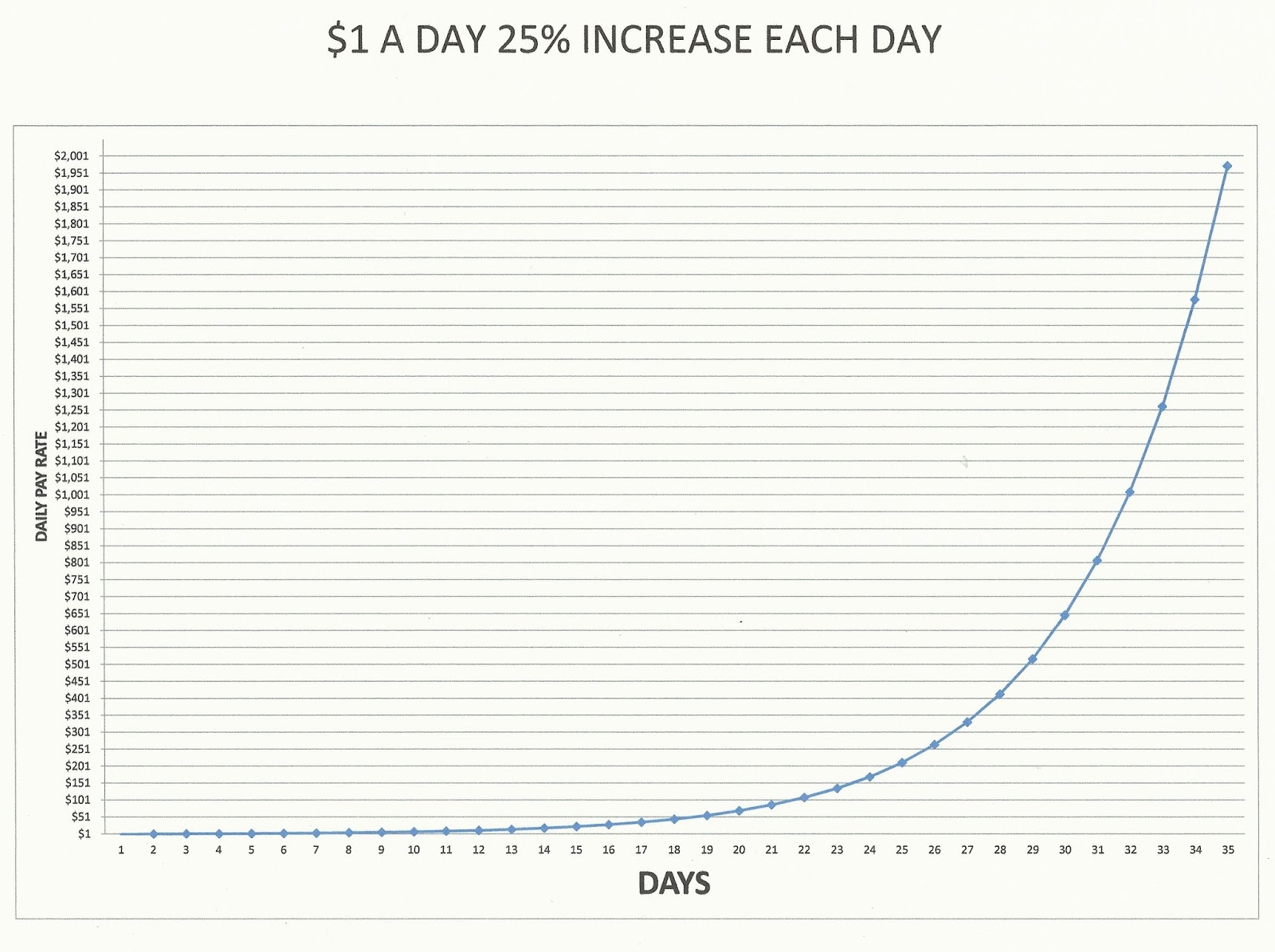
     B.      $1 a day with a 25% increase each day for 35 days!


GRAPH "B" DATA


2.      Questions

a.       Which strategy is the most profitable?

A $1 a day with a 25% increase each day is more profitable in the long term.

b.      Which would have seemed most profitable if you had stopped at six days?

       $6 a day with a $6 a day raise would have seemed more profitable in the short term or at day six.


Part II Measurements of Biodiversity, Field Methods, and Soil Testing


Field Work

1.       Sample site photo


2.       Quadrat photo


3.       Random numbers

          a.       1; 5; 6; 7; 8; 11; 12; 15

4.       Quadrat diagram

5.       Labeled specie sketches

6.       Specie Richness Data Chart
7.     Most species in the quadrat had a random dispersion pattern, in-other-words individuals among the different species have an equal probability of occurring at any point in the habitat.  Many of the species existed throughout the sections of the quadrat that I sampled, e.g. the weed with the yellow flowers.  Some species in the quadrat have a high probability of existing due to clumped dispersion, in-other-words the presence of one individual has increased the chances of another species living nearby.  For example, the larva that exists under a rock in quadrat 6 makes the probability of ants existing in this area higher since they feed on larva. 

8.     I was cautious to not be biased in my observations and collection of data to the point that I had two other individuals come into each quadrat square right after I had finished observing a square and had them observe and collect data.  Their data was the same as my data!

Soil Tests  

                  Location                                                N level/rating           P level /rating             K level/rating              Ph level/rating
Sample A        My side yard
                    where I plan to have a    
                       vegetable garden
                                                                             

3 Sufficient


4 Surplus

3 Sufficient

7 Neutral
Sample B          My front yard
                     where I plan to have a  
                          vegetable garden

4 Surplus

4 Surplus

4 Surplus

6.5 Slightly      
       Acidic


A.      What nutrient/chemical cycles are related to soil formation? Give two specific examples.
a.       The nitrogen and phosphorous cycle!
B.      Why is soil important?
a.       Soil can provide nutrients to support producers so they can grow providing nutrients or food and air to consumer species.
C.      How is soil type related to biodiversity and biomes?
a.       Biodiversity or the variety of species and the ecosystems in which they live and the processes of the ecosystem including nutrient cycling by the abiotic environment and biotic organisms in the ecosystem maintain topsoil fertility.  Biomes or regions such as forests, grasslands, chaparrals and deserts all have different climates that determine the type of ecosystem that will exist and determines the types of species that will exist in the region.  Regions with prevailing rain and lightning storms will have fertile soil and regions that are arid will have less fertile or depleted soil that will not support an ecosystem.  The biomes, their climates and its effect on soil will determine what species exist and biodiversity within the region.
D.      Name 3 factors that might cause soil type to change over time in short term (days to hundreds of years) or long (geologic) term.
a.       Rain and lightning storms quickly make soil moist and provide nitrates to topsoil.   Prolonged drought will deprive soil of nutrients and can cause degradation of topsoil.
Human activities that produce and release toxic chemicals into the soil can cause rapid or slow degradation of topsoil rendering it infertile.  Human’s removing natural vegetation that protects topsoil from rainfall and wind can cause accelerated erosion of the topsoil that can lead to degradation of topsoil.    

Photographs of soil testing process:

FRONT YARD


 SIDE YARD


These soil samples were taken approximately 2.5” below the surface of my side yard and the other from my front yard (rocks and grass were removed from sample.)  The PH test chamber was filled to the soil line with my soil sample then water was added to the water fill line.  Cap of comparator was sealed and then shaken thoroughly.  It sat for 1 minute then results were read in indirect sunlight.  The comparator was cleaned and the process was done again for the second soil sample.


FRONT YARD


SIDE YARD


These soil samples were taken approximately 2.5” below the surface of my side yard and the other from my front yard.  Two clean containers were filled with 1 cup of each soil sample and 5 cups of water were added to each.  Both samples were stirred well and sat for 4 and half hours.  The phosphorous, nitrogen and potash comparators were filled to the fill mark with the soil sample solution (no soil or other debris).  Powder from the colored capsules were added to each matching comparator then shaken thoroughly.  Each sample developed for 10 minutes then results were read in indirect sunlight.  The comparators were cleaned and the process was done again for the second soil sample.  

Tuesday, September 15, 2015

Lab 4

Part 1: Owl Pellet Dissection


Table 1: Pellet measurements:

       Length: 44.449 mm

       Width:  31.74 mm


Bones found in owl pellet:


Reconstructed rodent skeleton:


Table 2: Kinds and Number of Animals Found in Owl Pellets

   
# Rodent 
 # Moles
#Shrews
#Birds
# Others

      Your       Data
  1
   1
  1
  0           
   1


Bar Graph: Animals in Barn Owl pellet


Part 2: Ecological pyramids


Trophic (feeding) Pyramid for a 24-hour Period:


Equations for "Trophic Pyramid in a 24-hour Period":   

R = # 2˚ Consumers    
         # 3˚ Consumers  

            4  = 4 Ratio
            1

  # 1˚ Consumers = R (# 2˚ consumers)   

           4 (4)= 16    1˚ Consumers

  # Producers = R (# 1˚ consumers)  

            4 (16)= 64  producers
           

  1.   During the nesting season the young need an enormous amount of food for growth. If the nest contains three young and each of the young eat five mice per night for a month and the two adults eat four per night, how many mice would the parents have to capture in 30 days? 
              a.  690 mice would need to be captured to feed the family for 30 days.

        2.   The pellets are from what owl family?
              a.    Barn Owls

       3.   Environmentalists are concerned about the accumulation of certain poisons in predators. Why do you suppose owls, eagles, swordfish, humans and lions are often the most threatened organisms of a community that are exposed to DDT or mercury?
              a.  The process of biological magnification or substances that are bioaccumulators (toxic substances, e.g. DDT and mercury, that organisms absorb at a rate that is greater than that at which the substance can be processed out of the organism) cause concentrations of exposure to increase with each exposure.  The food that is consumed by the top feeders in a food chain may contain small amounts of toxins however these predators need to eat a lot of these organisms in order to survive which increases their toxic substance intake with every meal.     

Wednesday, September 9, 2015

Lab 3

9-09-15 

Part 1-Rachel Carson

1. Why do you think Carson titles this chapter “A Fable for Tomorrow?”

The first chapter of “Silent Spring” is appropriately named “A Fable of Tomorrow”.  I think Carson’s choice of words implies that there is a moral to the story and what may currently be a myth, tomorrow may not be a myth rather a reality.  So, we better heed the moral of her short story.

2. What did you know about pesticides before watching the Earth Days segment or reading part of Silent Spring?

My previous knowledge of pesticides is that these substances indiscriminately kill pests.  Killing some of these pests like roaches that spread diseases is necessary for the health of humans however at the same time these pesticides remove an important food supply or leaves a possibly dangerous food supply for invertebrates and vertebrates too eat.  They are also possibly still contaminating water and harming the organisms that live in these bodies of water.  In the past a pesticide DDT was being used in the U.S. and causing severe harm to many invertebrates and vertebrates and causing some species to become endangered.   Some countries still allow this substance to be utilized.

3. What do you feel so strongly about that you would want to fully dedicate yourself to it, producing a groundbreaking work of literature, film, music or other media, even if this risked your professional reputation and how others thought of you? Your answer can be hypothetical! Not everyone has a passion that they would carry this far.

I feel passionate about reducing greenhouse emissions and educating people about the recent data that has been collected via satellites.  This data provides us with a whole picture of the affects of greenhouse emissions.  I think this knowledge would help humans truly grasp how our Earth’s climate is globally interconnected and is directly affected by our actions or how we abuse our environment.  I think it would be equally important to provide knowledge of how to prevent greenhouse emissions in our daily lives.  I ultimately would like people to comprehend that we can prevent global warming and stop our Earth from reaching a tipping point in global climate change.

4. Name four places pesticides exist?

Pesticides exist in the soil and on crops in industrial agricultural farming and/or personal gardens. Genetically modified crops genetically have pesticides embedded in them.  As a result pesticides often end up in our food supply.  They also exist inside and outside of homes and businesses.  Rainfall run-off can leach soil of pesticides and flow into bodies of water.  Pesticides are absorbed and ingested by pests and other organisms.

5. What are two effects of DDT on birds and mammals?

DDT affected the food supply for birds through poisoning the food that birds ate.  DDT accumulates in fatty tissues causing it to move through the food chain.  Worms, fish and insects absorbed and/or ingested and accumulated DDT internally and this in turn caused many birds to die due to DDT poisoning.  A consequence of this was a population decline of some species of birds and that resulted in some species becoming endangered. DDT also affected the reproductive system of some birds and prevented certain species from producing healthy offspring through thinning of the eggshells and death of embryos.

DDT also affected mammals through ingestion that led to accumulation of DDT in the fatty tissues, e.g. fat cells and the brain.   In humans and other mammals it caused nausea, diarrhea, irritation and excitability and loss of muscle control through erratic movement or paralysis.  Liver damage occurred in humans and other mammals as well.  The reproductive system in some mammals, e.g. rats and bats, was affected making them sterile and/or they produced offspring that couldn’t survive.

6. “Our aim should be to guide natural processes as cautiously as possible in the desired direction rather than to use brute force...Life is a miracle beyond our comprehension, and we should reverence it even when we have to struggle against it...Humbleness is in order; there is no excuse for scientific conceit here.” – Rachel Carson in Silent Spring.  How can we exhibit humbleness in terms of our relationship to nature?

We can exhibit humbleness in our relationship with nature through performing extensive tests in new scientific advances.  Rather than allowing prideful and excited scientists to force their new ideas into action in our environment before we are aware of the consequences of those actions.  We can aim to aid natural processes rather than control and/or change natural processes.  Genetically modified crop seeds are a great example of scientific conceit and forcing nature’s natural process to change.


 Part 2-Biological Magnification diagram:


 Part 3-Birds of a Prey Make a Comeback


      The overall trend in the state of Georgia’s Bald Eagles population growth from 1990 to 2006 surveys and my graph above illustrates a consistent population growth! In the years 2004 and 2006 the state of Georgia didn’t do a survey on the population of Bald Eagles however in 2005 the graph displays that the population was stable.

     The average increase in the Bald Eagle population from 1990 to 2006 was 40.2. This represents a 583.333 percentage increase.

     Two programs that protect bald eagles: The Bald Eagle Protection Act of 1940 prohibits except under certain specified conditions the taking, possession and commerce in bald and golden eagles. The Migratory Bird Treaty Act of 1918 is a U.S. Federal Law that was enacted in order to implement international conventions with four countries that protects migratory birds. This law and international convention makes it unlawful without a permit to pursue, hunt, take, capture, kill or sell migratory birds, their eggs, parts and nests. This law includes migratory birds that are alive as well as dead.

Part 4-Ecological Footprint

    If everyone lived my lifestyle I predict that each person would need 2 Earth’s in order for there to be enough resources!


    My ecological footprint is 1.7 more Earth’s than my prediction. My lifestyle requires the use of 16.6 global acres of the Earth’s productive areas. If I keep up this lifestyle I am knowingly utilizing the Earth’s resources at an unsustainable rate. These results have humbled me and helped me realize my current negative impact on the Earth. There are many changes that I can make however I will only mention a couple. I am capable of reducing the amount of driving I do through carpooling when I leave town for groceries and other errands. I can start my own garden again so that I don’t have to drive to town for vegetables as often. All in all, I must improve my lifestyle to benefit my local and global environment.

Wednesday, September 2, 2015

Lab 2: The Cube

Question: “What numbers, letters, and color is printed on the bottom of the cube?”

Observations:
1. Two opposing sides are red.
2. Two opposing sides are white.
3. The top of the cube is the only red side and has the only name that starts with the letter F.
4. The two blue opposing sides have names that begin with the letter R.
5. The two white opposing sides have names that begin with the letter A.
6.  The top right number in each section of the cube represents the number of letters in the name.  7. The numbers on the bottom left of opposing sides are the same.
8. No one name on each side of the cube has the same amount of letters.
9. The names in each section of the cube increase by one letter: “Rob” starts this pattern.
10.  All of the names have vowels: white opposing sides names have two syllables; the blue opposing sides do not have the same number of syllables, however rob and frank both have one syllable; each name except, Roberta, has a partner with the same amount of syllables.
11. On the opposing sides one name is female and the other is male.


Hypothesis:

The numbers on the bottom are 8 and 4, the color is red, and the name will be a female name that starts with the letter F and it will have 8 letters and 3 syllables, e.g. Fantasia and Fayelynn.

The existing color patterns on the cube support my hypothesis that  the bottom of the cube is red. The evidence supporting this is that four of the six sides have an opposing side of the same color except the top red side whose opposing side is the bottom of the cube.

I can conclude that eight is the top right number on the bottom side because the number pattern is consistent and accurate on the five sides that have numbers.  I observed that each of the five sides has a name and a top right number, each sides number accurately accounts for the letters on that particular side.  Starting with the name “Rob”, containing three letters (which is represented by the number 3 located above the name) and ending with “Roberta”, containing seven letters (which is represented by the number 7 located above the name) and every name on each side increases by one letter but never decreases by one letter.

My conclusion about the name on the bottom of the cube being female, starting with the letter F and the name having to contain three syllables is supported by these three patterns I observed.  Pattern one: on both the opposing blue and white sides of the cube one name is female and the other is male.  Pattern two: The opposing sides that contain names start with the same letter, i.e., the opposing blue sides both start with “R”, Rob and Roberta, and the opposing white sides both start with the letter “A”, Alma and Alfred.  This indicates that the only side without an opposing name, the top of the cube with the name Frank, will have an opposing name that starts with the same letter. Pattern three: Each name except, Roberta, has a partner with the same amount of syllables: Rob and Frank, have one syllable each and Alma and Alfred have two syllables each.  Roberta has three syllables and no partner which supports the hypothesis that the bottom name will have three syllables.